
This is the same study with every parent measure taken out. Seven organizations rather than eight, because parents' groups is a tie to people inside the school rather than outside it. The finding holds, and the police result is larger than it is with parents in.
Introduction
Schools deal with organizations outside their own walls. Civic groups, local businesses and churches. Social services, mental-health providers, juvenile justice agencies and the police. Seven kinds in all. This study asks one question about them: what decides how many of them a school works with?
The answers come from the School Survey on Crime and Safety, which the US government sends to school principals. It ran six times between 2005-06 and 2021-22. We use 12,691 of the answers.
The survey also asks about parents: whether the school works with a parents' group, whether it has a formal process for consulting parents, how many parents turn up to school events. None of that is here. Parents are inside a school, not outside it, and this version of the study is about outside partners only. The companion site keeps them in, and the two differ in ways that are set out at the end.
Two things predict how many organizations a school works with.
The first is what the school runs itself: security staff, and security equipment such as cameras, metal detectors and locked doors. Schools with more of these work with more outside organizations, by about +0.23 of an organization for every standard deviation, a measure of how spread out a set of numbers is.
The second is the area around the school, as the principal describes it. Principals are asked to describe the crime level as low, moderate or high. Schools whose principals say high work with more outside organizations, by about +0.09 of an organization per standard deviation, even after what the school runs is accounted for.
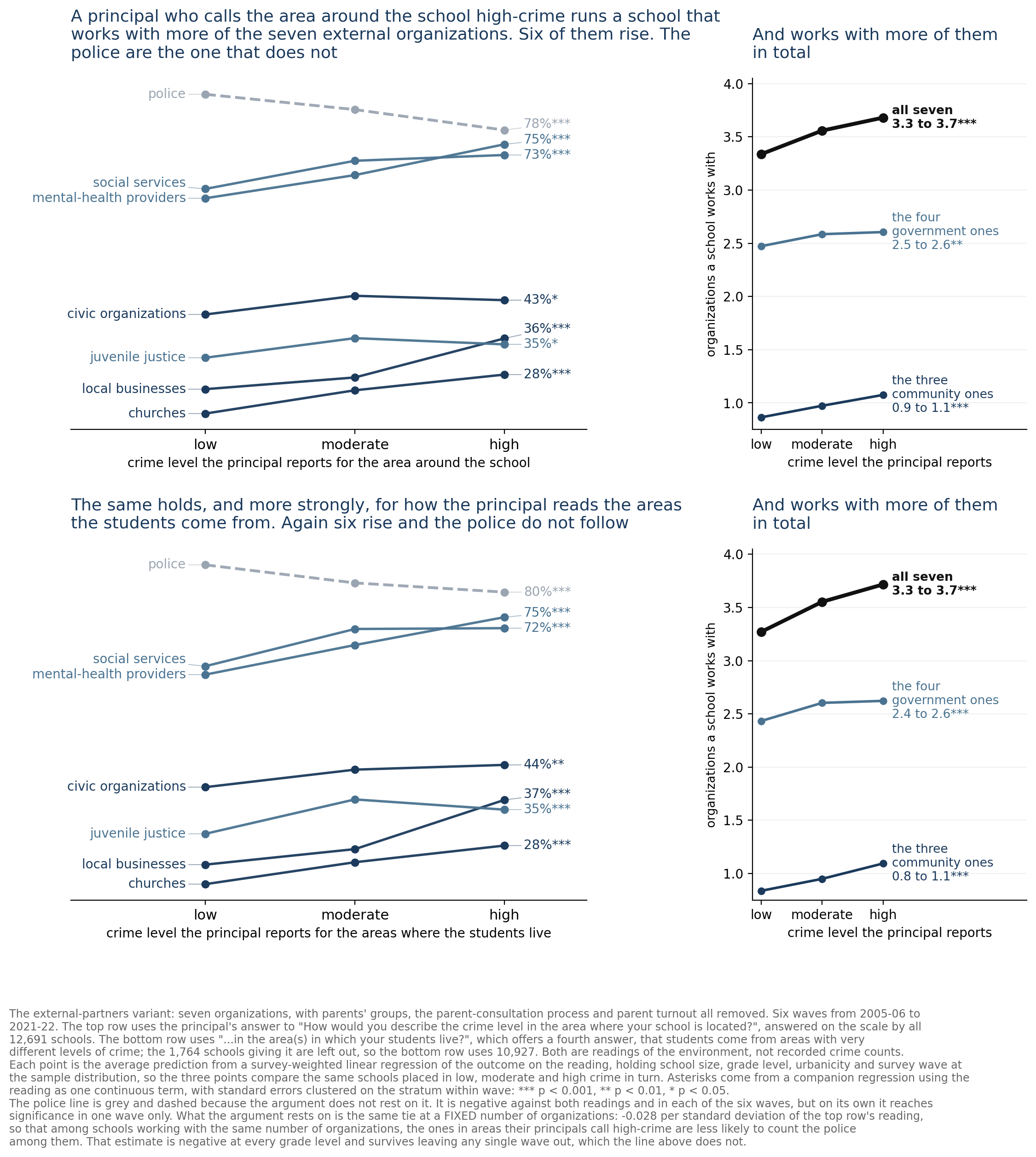
Then the finding this site exists for. Where a principal reports more crime, the school works with more organizations, and the police are the one partner that does not come along. Take two schools working with the same number of organizations. The one whose principal calls the area high-crime is about 10 percentage points less likely to have the police among them.